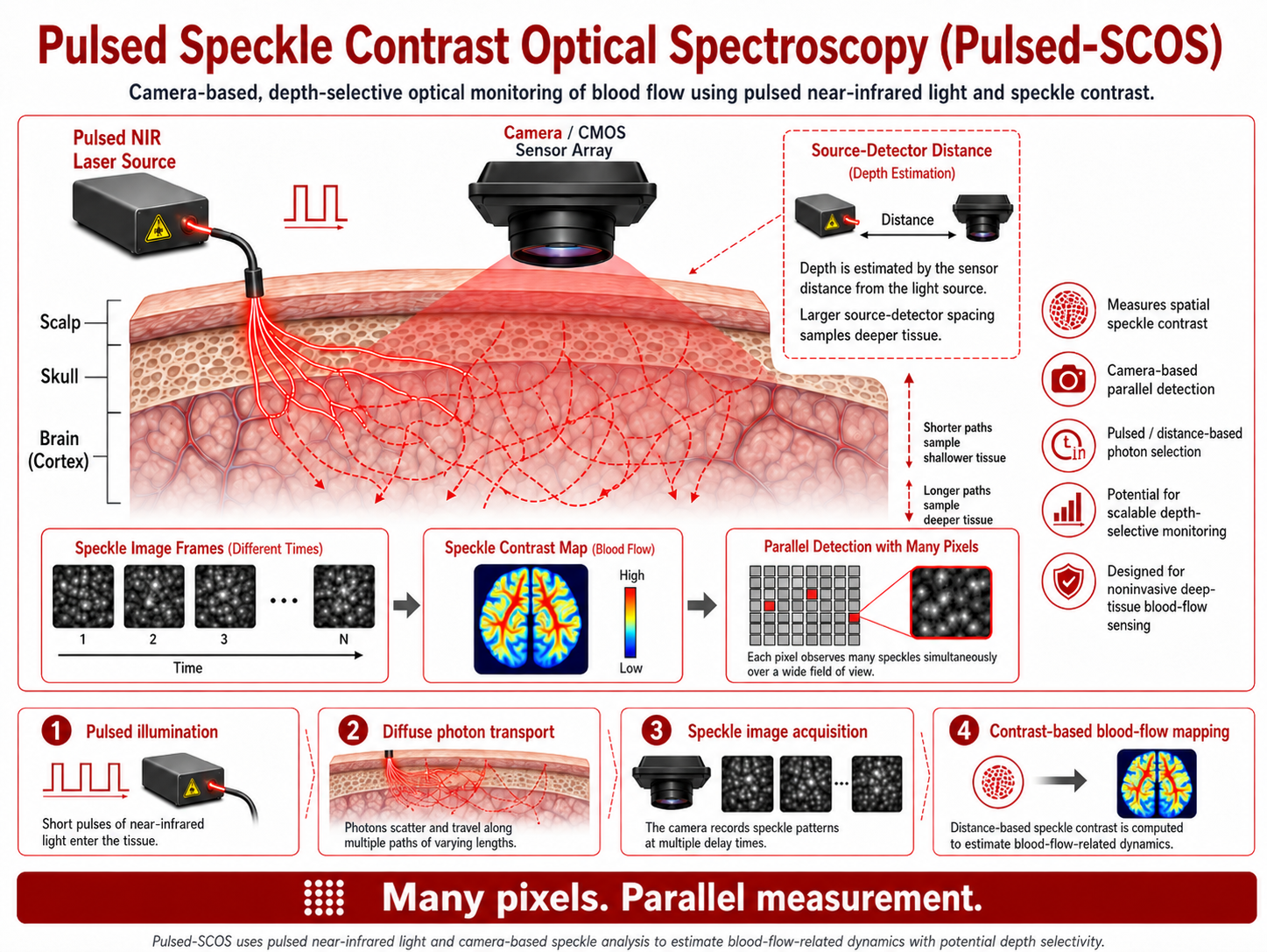
Pulsed-SCOS is a camera-based optical technique for measuring blood-flow-related dynamics in deep tissue using pulsed near-infrared light and speckle contrast analysis.
Pulsed NIR light enters tissue through the scalp and scatters through scalp, skull, and cortex.
Time-gating selects photons from specific time windows, helping emphasize different tissue depths.
A CMOS/camera sensor array captures speckle image frames in parallel.
Speckle contrast changes are computed to estimate blood-flow-related dynamics.
The approach uses many pixels simultaneously, enabling scalable, parallel spatial measurement.
Pulsed-SCOS is designed for noninvasive deep-tissue blood-flow sensing, including potential cerebral perfusion monitoring.
Deriving Blood FLow From a Speckle Image
Speckle Contrast Image
Data extracted from speckle image
Frame Sync
Frame 0 / 195
Set frame_base_url in HubSpotUpload the PNG sequence, then point this module to the folder URL.
Blood Flow Index
CMOS Camera Derived BFI
Open-Motion
BFI
4 second trace
Acquiring · press Pause to stop Each speckle image accounts for a single data point
Validating Open-Motion
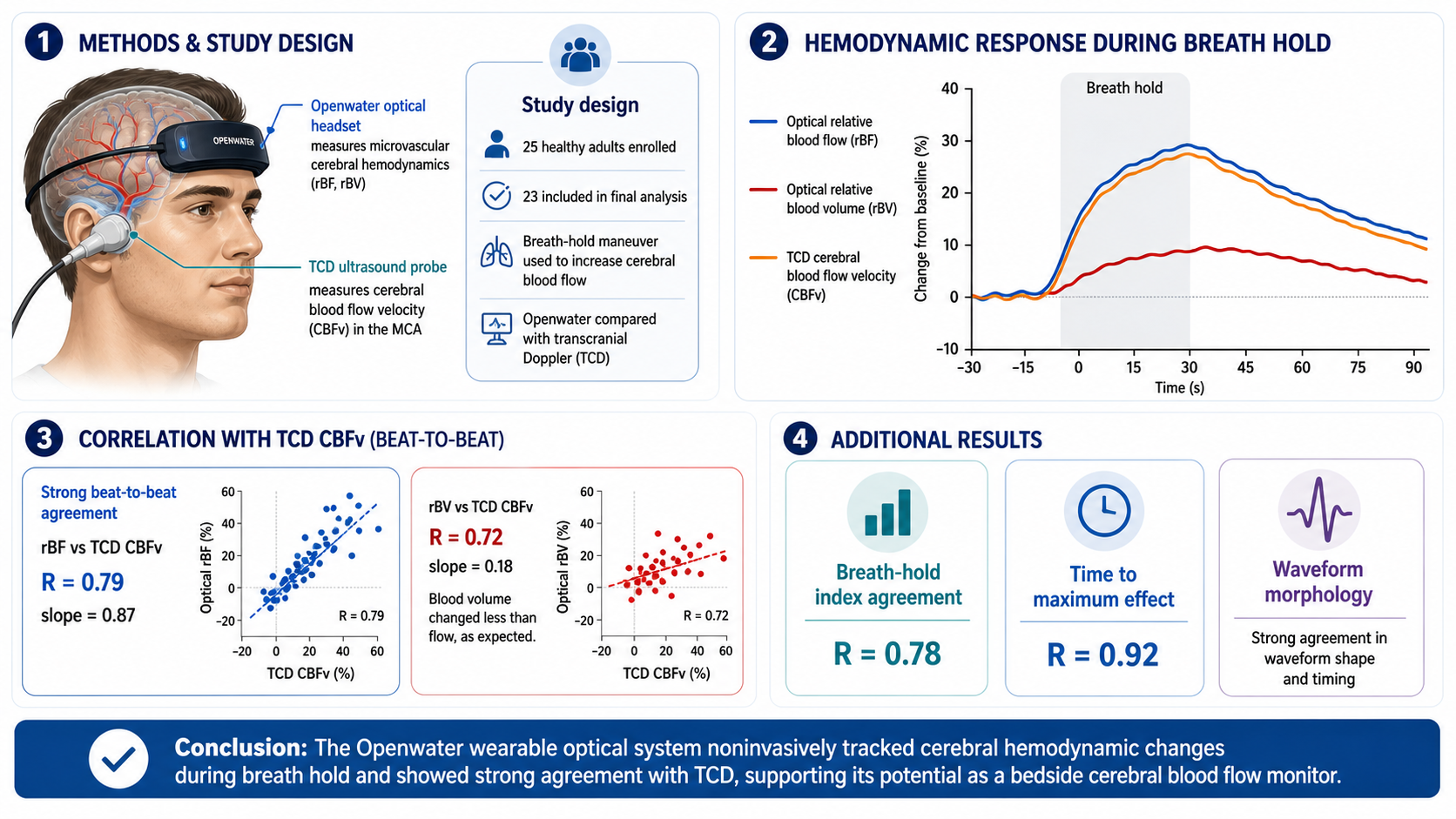
A peer-reviewed study published in Neurophotonics validates the Openwater wearable optical system for noninvasive cerebral hemodynamic monitoring. In 25 healthy adults, the system used laser speckle contrast to track changes in cerebral blood flow and blood volume during a breath-hold challenge, then compared those measurements against transcranial Doppler ultrasound. The results showed strong agreement between Openwater’s optical blood flow signal and Doppler-measured cerebral blood flow velocity, supporting the system’s potential as a portable bedside monitor for real-time brain perfusion.
Favilla, C. G., Carter, S., Hartl, B., Gitlevich, R., Mullen, M. T., Yodh, A. G., Baker, W. B., & Konecky, S. (2024). Validation of the Openwater wearable optical system: Cerebral hemodynamic monitoring during a breath-hold maneuver. Neurophotonics, 11(1), 015008. https://doi.org/10.1117/1.NPh.11.1.015008
At the Bedside
Real-Time Cerebral Hemodynamics
Averaged left vs right channels — BFI with overlaid BVI, scrolling at 40 Hz.

.png)