Low-Intensity Focused ultrasound
Open to Everyone
Open-LIFU is a fully modular, open-source low-intensity focused ultrasound platform — designed for researchers, clinicians, and developers who demand precision, reproducibility, and the freedom to build without limits.
Three components. Infinite configurations.
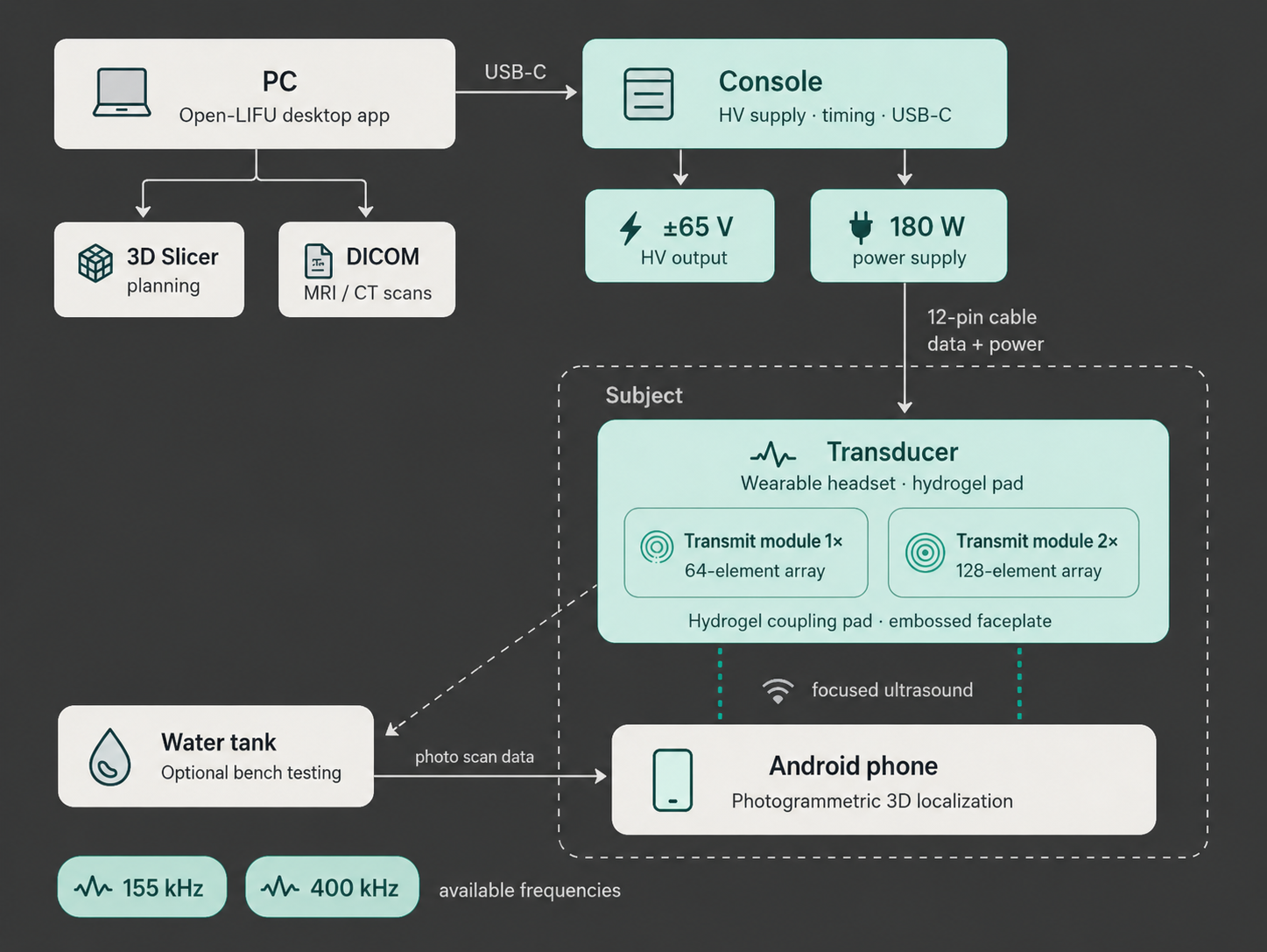
The Open-LIFU hardware platform is built around a clean separation of concerns — a powerful console, a wearable transducer, and the supporting software stack that ties it all together. Each element is documented, serviceable, and open for extension.
Console. The control brain. Generates high-voltage drive signals (up to ±65 V), coordinates timing, and communicates with your PC over USB-C. Compact at 3 lb — fits any lab bench.
Transducer. A wearable headset housing one or two 64-element 2D matrix transmit modules. Ships with a disposable hydrogel coupling pad and spatial-localization markings built in.
Software stack. A five-layer open-source stack — from 3D Slicer treatment planning to a low-level transmit-module SDK. Runs on Windows 11 with NVIDIA CUDA for real-time processing.
.
Precision you can measure.
Every parameter in a sonication sequence is fully programmable — pulse frequency, focal pressure, duration, repetition interval, and train count — giving researchers exact reproducibility across sessions and sites.
64 Elements per transmit module (2D matrix array)
1× or 2× Transmit module configurations for shallow or deep targets
2.16 MPa Peak negative pressure — dual 400 kHz config, derated
3–11 cm Axial steering range (2× configuration)
0–1200 kPa Programmable focal pressure range
10 MHz Beamformer clock for fine-grained phase control
Available at 155 kHz or 400 kHz, each in 1× or 2× configuration.
Built for subjects, not just benches.
The transducer ships as a soft-strap headset with foam padding for a comfortable, non-slip fit. A water-based polymer hydrogel coupling pad conforms to curved surfaces like the forehead, eliminating air gaps and maximizing acoustic transmission — no messy gel bath required.
An embossed faceplate pattern enables photogrammetric 3D localization via a standard Android phone — spatial tracking without the overhead of external navigation hardware.
Know exactly where you're sonicating.
Open-LIFU uses your Android phone's dual camera to reconstruct a 3D mesh of the transducer's position relative to the subject. That mesh feeds directly into the treatment-planning software, letting you target with anatomical precision before the first pulse is fired.
- No external tracker needed. Localization runs on your existing phone hardware.
- DICOM-compatible. Import MRI or CT scans for target registration.
- 3D Slicer integration. Familiar environment for neuronavigation and planning.
Open. Always.
Open-LIFU isn't a black box. Every hardware schematic, firmware file, and software layer is published and community-licensed — so you can validate, extend, and build on a foundation you actually understand.
|
Hardware under CC BY-SA 4.0 · Documentation under CC BY 4.0 Fork the repo, file an issue, or contribute a pull request. The community lives on GitHub and Discord — from independent researchers running single-site studies to teams building novel neuromodulation protocols. |